The Real Goal Isn't Search. It's Delegation.
Most people think ChatGPT, Gemini and Claude are trying to build better search engines.
I don't think that's the end goal.
Google didn't spend twenty years training us to search only to hand that relationship to ChatGPT. That's why Google is aggressively rolling out AI Overviews, Gemini and agent-powered experiences. Every major technology company wants to become the layer between consumers and the internet.
Whoever owns that layer owns the customer relationship. That's why Google, Microsoft, OpenAI and Anthropic are investing billions into AI assistants. The prize isn't better search. The prize is becoming the place where decisions are made.
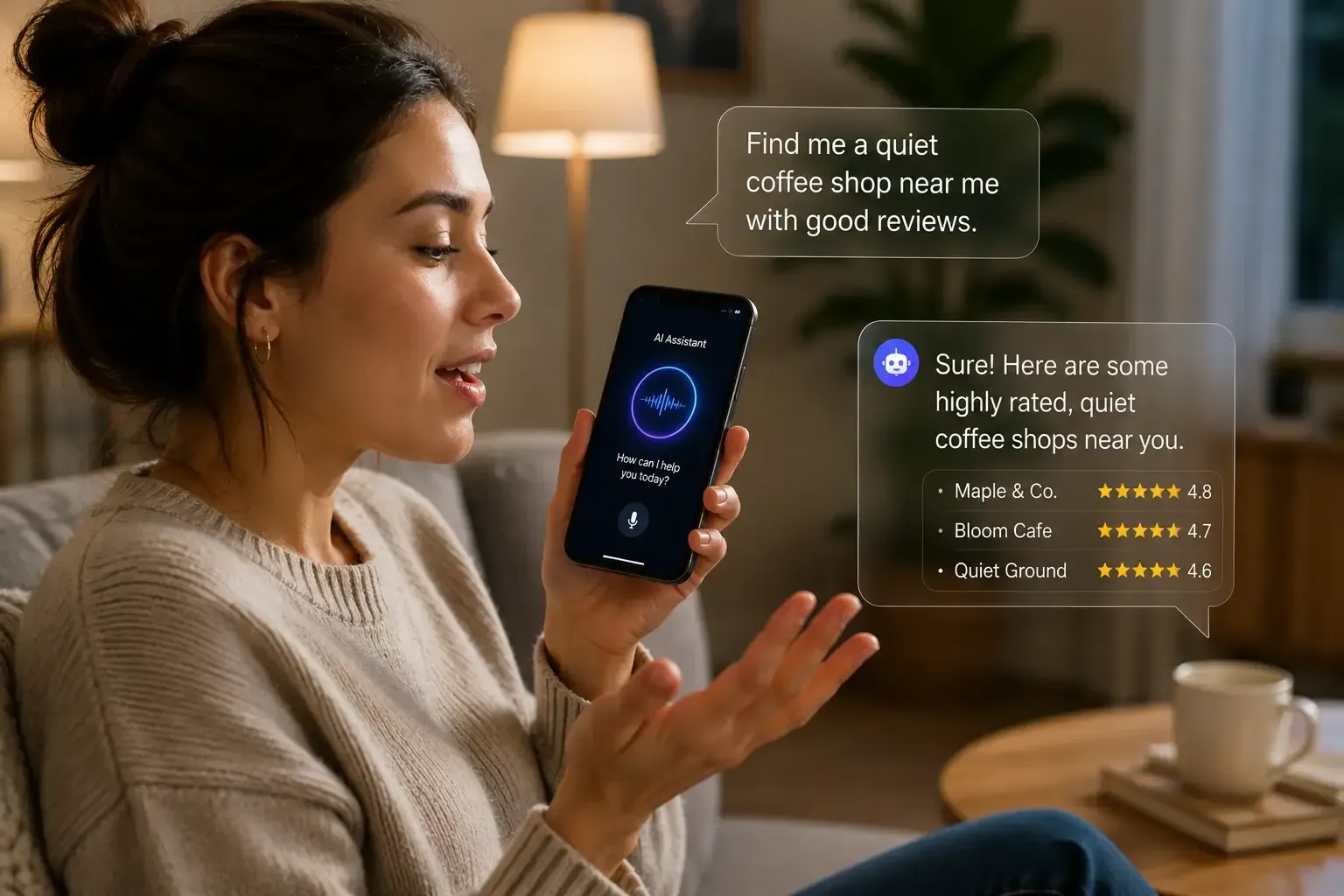
The real goal is becoming your personal assistant.
Rather than opening ten browser tabs, you'll increasingly ask AI to:
- Research suppliers
- Compare products
- Find restaurants
- Book holidays
- Schedule appointments
- Complete purchases
And this isn't a future prediction.
It's already started.
OpenAI's latest
agentic AI capabilities allow ChatGPT to browse websites, compare information and complete multi-step research tasks on behalf of users.
Gartner predicts that by 2028, at least 15% of day-to-day business decisions will be made autonomously through agentic AI.
If they're even half right, the shift from AI answering questions to AI taking actions may happen much faster than many businesses expect.
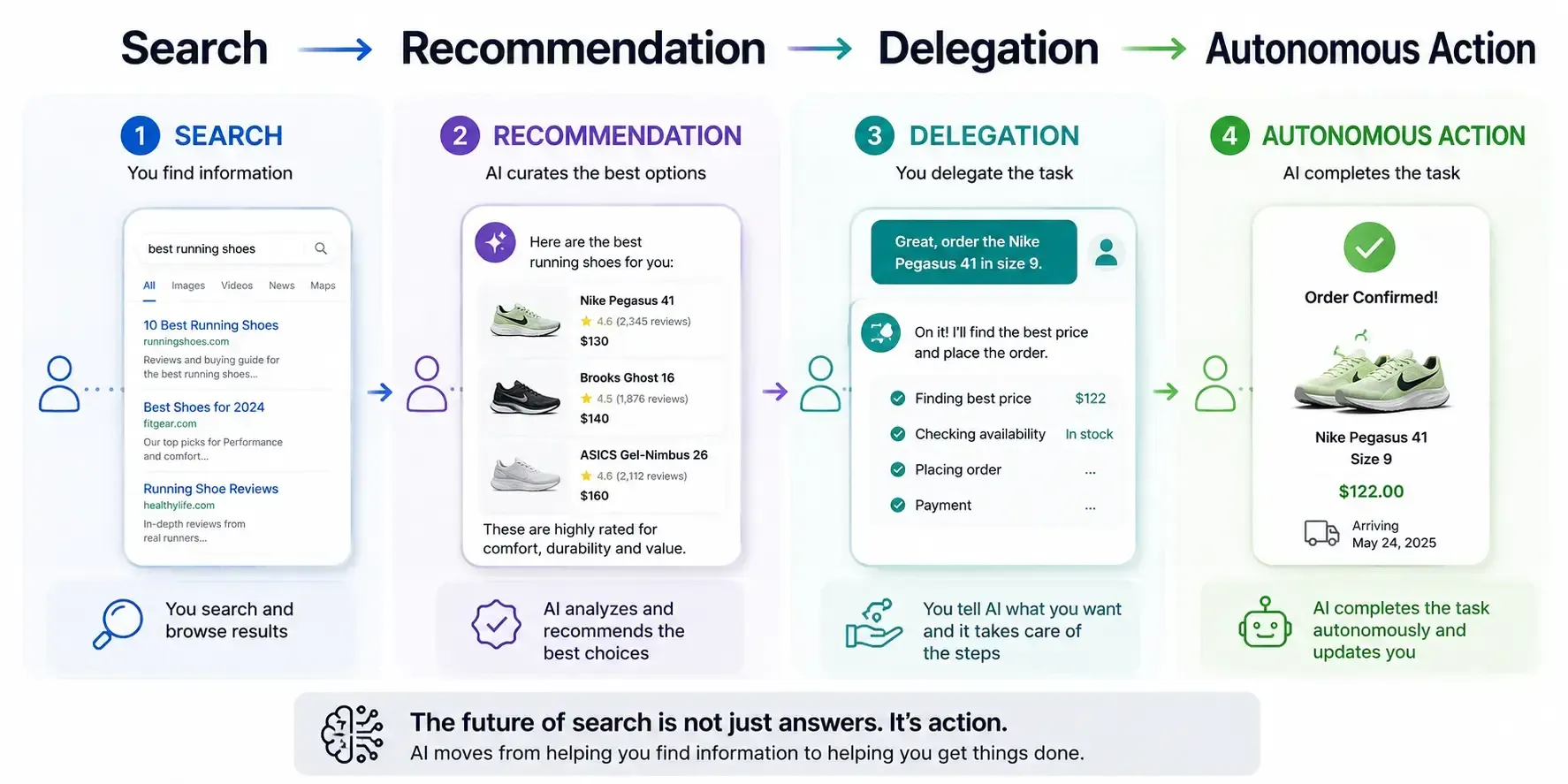
The shift is from searching to delegating.
For the past two decades, consumers have searched.
Over the next decade, they'll increasingly delegate.
Imagine saying: "Find me a family-friendly restaurant within 15 minutes of my house that has great reviews and outdoor seating."
Or:
"Book me a holiday in Fiji during the school holidays for under $8,000."
Or:
"Find a plumber who can replace a hot water cylinder tomorrow morning."
Today, AI might give you recommendations. Tomorrow, it will likely make the booking.
- The AI becomes the researcher.
- The AI becomes the comparison engine.
- The AI becomes the decision support tool.
- Eventually, it becomes the buyer.
What Happens To Websites?
This is where things get interesting.
For years, marketers have treated websites as destinations.
Everything revolved around getting traffic.
- SEO generated traffic.
- Google Ads generated traffic.
- Social media generated traffic.
- Email marketing generated traffic.
The website was the destination.
In the AI era, the website increasingly becomes a source.
AI systems visit websites, gather information, compare options and then present recommendations back to users.
In some cases, the customer may never visit the original website at all.
The website still matters.
Arguably more than ever.
But its role is changing.
Zero-Click Searches Are Accelerating
Google's AI Overviews are already changing user behaviour.
According to Similarweb research, the percentage of news-related Google searches ending without a click to any website increased from 56% to 69% following the rollout of AI-generated answers.
In other words, more users are getting what they need directly from Google without ever visiting a website. For businesses that depend on organic traffic, that's a trend worth watching closely.
Ecommerce Businesses Should Be Paying Attention
I believe ecommerce businesses will feel this shift before most service businesses. Imagine somebody asks:
"What's the best coffee machine for a small office under $1,500?"
The AI might compare:
- Features
- Reviews
- Warranty information
- Product specifications
- Pricing
- Availability
- Then present a shortlist.
The customer doesn't browse category pages.
The customer doesn't compare dozens of retailers.
The AI does.
In the past, ecommerce businesses fought for rankings. Increasingly they'll compete for recommendations. That's a very different game.
In many cases, the AI won't recommend ten options. It may recommend three. Or one. That dramatically changes how businesses compete online.
For ecommerce businesses, the challenge becomes:
Will the AI recommend your products?
Not:
Will the customer find your website?
That's a profound shift in thinking.
Why Traditional SEO Is No Longer Enough
SEO isn't dead.
Far from it.
Good SEO still matters.
Technical SEO still matters.
Content still matters.
Authority still matters.
But the goalposts are moving.
Traditional SEO focused on:
- Rankings
- Keywords
- Traffic
- Clicks
The AI era focuses on:
- Trust
- Authority
- Expertise
- Recommendations
The question is no longer:
"Can Google find us?"
The question is increasingly:
"Would an AI confidently recommend us?"
Those are very different questions.
Digital Shelf Space
Google page one traditionally offered:
- 10 organic listings
- ads
- maps
- videos
- images
An AI assistant may only mention:
- 3 businesses
- 2 products
- 1 supplier
That's a massive reduction in visibility.
The Businesses That Win Will Be Easier To Understand
AI doesn't care about marketing fluff.
It cares about clarity.
It wants to understand:
- What you do
- What you sell
- Who you help
- Why customers choose you
- What makes you different
Many websites still lead with generic statements like: "We're passionate about delivering exceptional service."
That tells an AI absolutely nothing.
A better approach is specific information.
- Clear explanations.
- Real expertise.
- Case studies.
- FAQs.
- Product details.
- Comparisons.
- Evidence.
The easier your business is to understand, the easier it becomes to recommend.
Businesses with accessible APIs, structured data and connected systems will be far easier for AI agents to transact with than businesses relying on forms, PDFs and manual processes.
The 4-Question Agent Readiness Audit
Most businesses are asking: "Are we ready for AI search?"
I think the better question is: "Are we ready for AI agents?"
Because AI assistants won't just answer questions.
They'll increasingly perform tasks.
Here's a quick audit worth running this week.
1. Can An AI Clearly Understand What You Sell?
Could an AI easily access:
Product information?
Service descriptions?
Pricing?
Availability?
Reviews?
FAQs?
Or is that information scattered across spreadsheets, PDFs and disconnected systems?
2. Is Your Data Accurate Everywhere?
Are your:
Prices current?
Stock levels accurate?
Product details consistent?
Service information up to date?
AI systems trust businesses with clean, consistent information.
Customers do too.
3. Could An AI Place An Order?
This sounds futuristic.
It's not.
Can a machine:
Query your products?
Check availability?
Confirm pricing?
Make a booking?
Place an order?
If not, now is the time to start thinking about it.
Because agentic commerce is arriving much faster than most people expect.
4. What Internal AI Opportunities Exist?
The same foundations that support AI-driven customer interactions can support your staff.
The same structured data can power:
- AI sales assistants
- Customer service automation
- Internal knowledge systems
- Product recommendation tools
- Procurement assistants
The businesses that win won't build separate AI systems. They'll build one connected foundation.
The Biggest Change Since Google?
I genuinely believe this may be the biggest shift in digital marketing since Google became mainstream.
Not because AI is replacing websites.
Not because AI is replacing marketers.
But because AI is changing how customers make decisions.
The internet was built around browsing.
The next generation of digital experiences will be built around delegation.